
Will AI replace social media managers? No, the job changes
Can an AI social media manager replace you? AI takes over more production work, not the manager. What shifts, what stays with people, and the skills to build.
Sooner or later a client asks it, half joking: if AI can write the caption, what exactly are we paying you for?
Behind the joke is the question a lot of social media managers ask themselves: will AI replace me? Our answer is no. We don’t believe AI will replace social media managers, but it does change the job. AI takes on more of the production work around the post, and the job moves from making every post by hand to deciding what gets said, directing the AI that helps make it, and checking the result before anything goes out. The managers who do well are the ones who get good at that, not the ones who keep AI at arm’s length.
Where AI already sits in the work
Start with work in general, beyond social media. In the World Economic Forum’s Future of Jobs Report 2025, published in January 2025, employers estimated that 47% of work tasks are done mainly by people alone, 22% mainly by technology, and 30% by a combination of both. By 2030, they expect the three to be nearly evenly split.
Read that forecast carefully. By the employers’ own estimate, work that people and technology do together grows too, and work done by people alone still makes up about a third. That’s the shape we see social media work taking.
What AI takes on
The tasks moving to AI are the ones that are about volume and first passes:
- First drafts: captions, hooks, scripts, and outlines to react to.
- Variations: five versions of a hook, a shorter cut for Stories, a more formal take for LinkedIn.
- Research: summarizing a trend, a competitor’s recent posts, or a client’s last quarter of comments.
- Resizing and reformatting: turning one piece into the sizes and lengths each platform needs.
- First-pass analysis: spotting which posts did well and suggesting why, for a person to question.
None of these is the job. They’re the work around the job.
What stays with people
What doesn’t move is the part that decides whether a post is worth publishing at all:
- Strategy: what this brand is trying to achieve on social, and which posts serve it.
- What to say, and what not to say: the joke that lands with this audience, the topic to stay away from this month.
- Voice: whether a draft sounds like the brand or like every other account in the feed.
- Relationships: knowing the client, the business, and the people behind the account well enough to know what they’ll sign off on.
- Approvals and risk: the final say, and the judgment call on anything that could go wrong in public.
This is where people lead and AI helps. A team that hands the thinking to AI gets posts that look like everyone else’s. A team that uses AI for the work around the thinking gets more time for the part only it can do. And as AI content grows, that part gets more valuable, not less: we wrote about why generic AI content loses reach.
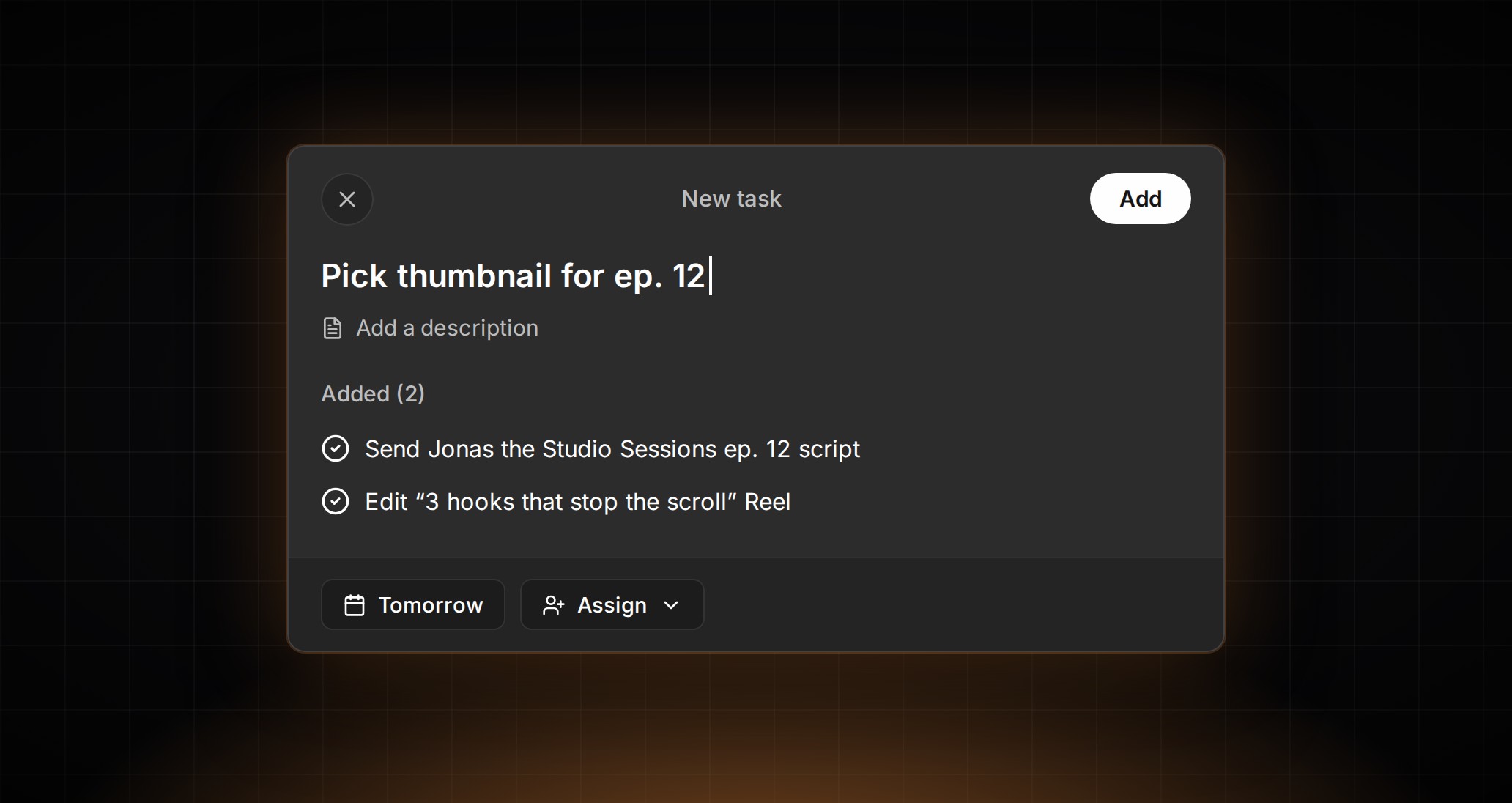
In ContentCrew, AI writes hooks, captions, and hashtags from your brand guidelines, your team decides what goes out, and clients approve through a review link without logging in.
The skills that grow in value
The World Economic Forum’s report found that employers expect, on average, 39% of workers’ existing skill sets to be transformed or become outdated between 2025 and 2030. AI and big data top its list of fastest-growing skills, while human skills such as creative thinking stay in high demand, along with resilience, flexibility, and agility.
For a social media manager, that turns into a fairly concrete list:
- Briefing AI well. A good brief to a person and a good prompt to AI have the same parts: the goal, the audience, the voice, what to avoid, and an example of good. Write those down clearly, and the first draft that comes back is much closer to usable.
- Editing for voice. Taking a competent draft and making it sound like the brand, with the specific detail only the team knows.
- Judgment on risk. Spotting the claim that needs checking, the image that needs a label, the post that shouldn’t go out today.
- Knowing the client or the business. The context AI doesn’t have: what the CEO hates, what the last campaign taught you, what the sales team keeps hearing.
- Reading the numbers. AI can summarize performance. Deciding what to change because of it is still yours.
- Designing the workflow. As AI tools start to handle chains of steps on their own, someone has to decide which steps those are and where a person checks the work. That’s what an agentic workflow is, and setting one up well is a skill in itself.
What to do this month
You don’t need a new job title to start working this way. A few things to try before the month is out:
- List your week. Write down the tasks from one normal week and mark each one: does it need your judgment, or is it a first pass? The first passes are where AI can help.
- Write one brand brief for AI. Put the voice, the audience, the topics to avoid, and two or three posts you’re proud of on one page. Use it every time you ask AI for a draft.
- Move one recurring task. Pick something you do every week, such as caption variations or a first read of last week’s numbers, and hand the first pass to AI for a month.
- Keep the final say. Make it a rule that nothing goes out until a person who knows the client has approved that exact version.
- Show the split. Tell your manager or your client which parts of the work AI now does the first pass on, and which decisions stay with you. It makes the part of your job that AI doesn’t do visible.
When the client asks what they’re paying you for, that list is a good answer: the decisions, the voice, and the final say, with AI doing more of the work around them.